The Campaigner Crunch
New funding is exacerbating a critical shortage of talent in animal advocacy. How we got here and how we get out.
This is the first of at least two posts on the talent shortage in animal advocacy. This one focuses on the inputs, why we are struggling to find new campaigners. The next post will focus on the nefarious internal conspiracy to steal our best talent away from the top.
In this post:
Farmed animal advocacy is in the midst of a significant increase in funding.
We are already critically bottlenecked on talent, especially founders and effective campaigners, limiting our ability to make the most of new money.
The leadership gap is made wider by several problems:
Flagship organizations have stopped investing in the volunteer organizing that produced most of our current campaigners and leaders;
We kind of suck at hiring, but it’s haaard; and
Our aura is broken, so that many great people don’t want to work on factory farming despite it being OBJECTIVELY THE WORST PROBLEM IN THE WORLD.
Who will save us from this talent crisis?
One thing you can do this month to strengthen our leadership pipeline is to attend the Anti-Fur March during Milan Fashion Week on September 26. There is a certain number of attendees at this march that would be enough to win the campaign, toppling one of the last pillars holding up the hated fur industry. The legendary Coalition to Abolish the Fur Trade have computed this number to within a single order of magnitude: somewhere between 1,000 and 10,000. With two weeks to go, there are over 600 people signed up, which you will notice is less than 1,000, but not so much less that your decision to attend wouldn’t make a difference. So join me on an upcoming organizing call with the CAFT team, Sept 14 or 20th at 7:30 pm CET.
But wait, you ask, what does immiserating Milan Fashion Week have to do with our inability to scale insect welfare campaigns? When there are 2gazillion trillion shrimp having their eyes gouged out every second, why even get out of bed for a meager 20 to 100 million foxes, minks and raccoon dogs?
1. Party tricks
Industrial activity requires three elements: land, labor, and capital, the classical economic “factors of production.” Land is necessary to grow or extract natural resources, from wheat and timber to minerals and fuel. Labor converts these raw materials into marketable goods. Capital encompasses the physical and conceptual infrastructure necessary for that conversion, from factory equipment to market position.
Altruistic activity has its own factors of production: people, resources, and strategy. Two thirds match up: to change the world, you need people to do work, and you need money for them to buy things. Besides that, all you need is a good plan.
I recall many late night conversations from years past with fellow animal advocates centered on which of these three factors was our tightest bottleneck to creating more change for animals. About five years ago in particular, it was widely argued that the movement was primarily constrained on funding. With corporate welfare campaigns, this view held, we had finally found a reliable strategy to convert money into change for animals. The formula was so precise, we could hire competent generalists without movement experience to execute on it. In fact, trading in our unwashed punk activists for starched-up professionals with shiny corporate resumés and no visible tattoos would probably be an upgrade. The strategy was solid, the people were out there; we just needed money.
It was not a hard case to make. Factory farming is the worst extant problem in the world even according to conservative assumptions about how much farmed animals can suffer relative to humans. Yet of all charitable dollars, only 1% went to animals, and less than 1% of that 1% went to farmed animals. Animal Charity Evaluators introduced this infamous visualization:
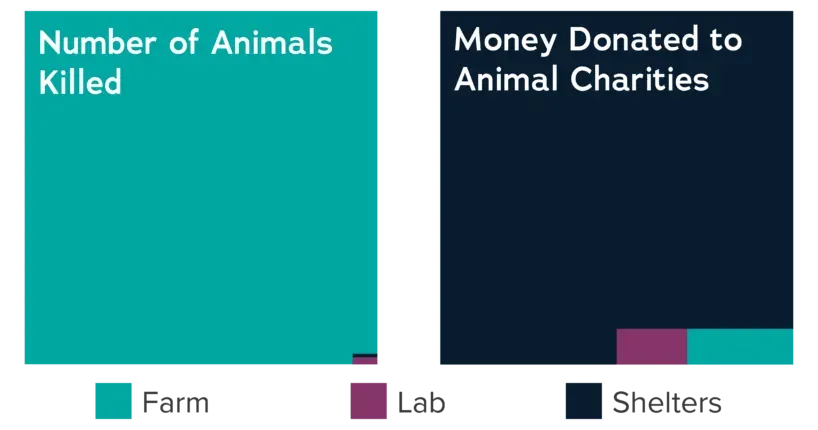
Two things about this graph. First, it’s true, and that is absolutely insane. A catastrophic moral failure by society as a whole. We spent less than $300M fighting factory farming in 2024, barely a third of what Americans spent on Halloween costumes for their pets.
Second, though, is that this doesn’t necessarily prove that funding is the main bottleneck for animal advocacy. As pitiably underfunded as we are, we could theoretically be even more impoverished in either of the other factors of altruism: capable, motivated people, and strategies that can scale.
Even five years ago, I often found myself arguing this was the case. It may have just been my contrarian streak, but I think it was due to my experience in the grassroots wing of the animal movement. At its best, the grassroots thrives at mobilizing large numbers of volunteers to sacrifice their free time, among other things, to the cause. I’d seen this work wonders in the golden years of DxE, the Save movement, and Anonymous for the Voiceless, all of which peaked in participation around 2018. I thought that if we played our cards right, we could generate that kind of enthusiasm again, unlocking a lot of capacity for the movement without extra money. I’d even seen larger budgets make some organizations less effective, not just per dollar but in total. As DxE’s budget grew, we became less resourceful, less creative about how to make awesome things happen with volunteers. Money meant there was something to fight over, intensifying power struggles within and between grassroots groups.
This made a great party trick: whenever me and my grassroots friends argued to a room full of funders that the movement was, if anything, overcapitalized, that our true bottleneck was leadership capacity, you could hear jaws hit the floor.
2. Mo’ money, mo’ problems
Those days are gone.
Two things have changed. First is the wave of new funding expected to reach animal welfare next year from the IPOs of major AI companies staffed by effective altruists. We shouldn’t overstate this philanthropic windfall; donors from OpenAI and Anthropic could double the budget of farmed animal advocacy, but we can’t count on anything like pet Halloween costume money, let alone dog and cat rescue charity money. (To all the journalists lurking around for stories about tech billionaires1 imposing basic decency on unwitting American meat consumers, you’re all lying bastard sharks and the deepest ring of hell is waiting for you.)
Nobody knows for sure how much money new donors will bring into animal welfare in the coming years, but even the lowest estimates would be enough to fund basically the entire menu of programs that people had in mind five years ago when talking about animal advocacy being funding constrained.
Once again, that alone doesn’t mean the movement isn’t funding constrained. In the limit, enough money could replace the other factors of altruistic production entirely. With trillions of dollars a year, we could just pay everyone to stop eating meat. With tens of billions, we could buy the genetics companies that breed nearly every animal in industrial farms, and replace the current breeds with genetically engineered painless animals.
The same fanciful dynamic could apply in reverse; a mass social movement on the scale Black Lives Matter could transform public opinion without spending a penny. That’s what I used to mean when I thought about the people factor. Unfortunately, the astute reader might notice that a major shift in public opinion around animal rights would apparently be necessary before millions of people would take to the street. Years of trying to spark a mass movement have moderated my expectations of the scale of public mobilization possible for animals in the short term (and maybe ever) from hundreds of thousands to mere thousands.2 Now when I think about people, I’m more focused on the remarkable achievements a few highly determined campaigners can make when equipped with the right skills, resources, and strategy. (Throughout this post, I use campaign and campaigner in a broad sense, inclusive of most/all frontline work.)
The practical question we face is what to prioritize to make the most of what we will have. What’s the best we can do with a billion dollars? And could we create twice as much impact—or even more—with two billion?
That brings us to the second change since five years ago. The leadership crisis that was simmering then has reached a vigorous boil.
3. Pulling up the ladder
I often talk to job seekers who are understandably confused by two conflicting messages. On one hand, they’ve heard the movement is talent constrained. Yet remote job postings are fiercely competitive, often attracting hundreds of applicants. How to square these two?
There are different types of talent. If I could only add one wrinkle to our three factors of altruistic production—people, resources, and strategy— it would be to subdivide people into leadership and specialists. Specialists have expertise in narrow technical domains, from graphic design and digital marketing to engineering and biotech. There are some technical roles we have a hard time filling, but we are much more constrained by the other type of talent.
By leadership, I don’t necessarily mean the ability to oversee a large organization. I mean people who have the grit to forge a path nobody has gone down before. Founders are usually generalists; they aren’t defined by any hard skill so much as an obsessive, relentless drive to teach themselves whatever skills they will need to succeed at the task they have set out on. And like for-profit entrepreneurs, they usually spend months or years hacking away at their vision before ever seeing their first paycheck.
Campaigning sounds like a specific role on the surface, but it turns out to match the skill profile of the founder. Every campaign is unique, and great campaigners are defined by tenacity and improvisation more than by any hard skill.
Founders and campaigners are the people who turn money into impact for animals. Without them, an extra billion dollars will sit there gathering interest.
Where will we find new leadership capacity? Think of an animal advocate you deeply admire, someone who has made real change for animals during their life. Chances are, that person has made the movement their career, and now takes a modest salary for helping animals– but they started out as a volunteer, organizing a local group or a club on campus, or volunteering/interning with some organization’s campaign. Nearly every important leader I can think of in the movement climbed this ladder; almost none got their start through an open hiring round.
But a few years ago, those leaders made a crucial mistake and pulled the ladder up behind them, making it harder to follow in their footsteps.
The discourse about the funding bottleneck was part of a larger trend, which proponents and opponents alike dubbed professionalization. This became a keyword in movement strategy some time in the last decade– and a source of much misunderstanding. When we think of acting more professional, in part we think of showing up to zoom calls on time and dressing appropriately for meetings with politicians. Taking ourselves seriously in this way is something I hope we can all agree on.
But professionalization was also a trojan horse for a more specific set of ideas, which, to differentiate, we’ll call McKinsification after the infamous management consulting firm, avatar of the corporate culture mocked by Dilbert and Office Space. The gospel of McKinsification in animal advocacy held that:
Volunteers are great at showing up to protests to hold signs, but usually can’t be relied on for more complex tasks;
If a paid staff organizer has an option of delegating a task to a volunteer, training them to do it, and holding them accountable for following through on it, it will take less time for the organizer to just do the task themselves;
Now that we’re on the subject, regarding all these people who started out in the movement as fanatically dedicated volunteers and are now managers of large departments or even entire organizations of more than 100 employees… These folks are great and all but most of them don’t have any training in management or leadership, or even any experience working in a proper professional organization. Wouldn’t it be better to just hire MBAs from McKinsey to run these organizations? Surely there are MBAs who care about animals.
OK, we talked to some McKinsey MBAs and they get paid a lot of money. If we want any of them to start work for us—and keep working for us once they settle down and start a family—we need to, like, quadruple our salaries. There are a few very capable people willing to live like monks in order to campaign for animals, but we’ve already found all of them.
The problem with these commandments was that they were more or less true. Counting on volunteers to execute mission-critical tasks on time is a game of Russian roulette. When it works, it’s the best way for an experienced campaigner to develop new leaders– but even that is costly in the short term, because mentoring people to do things is way more work than just doing them yourself. And when those people are volunteers who may well abandon the project midway and then stop showing up to meetings altogether and never be heard from again, it becomes genuinely hard for managers to sustain.
Worse still, the manager in question is actually just some asshole in their 20s with a music degree and no marketable skills (ahem) who is not obviously qualified to manage anybody.
When Open Philanthropy money first flowed into animal welfare circa 2016, there was really only one way things could go. First, everyone got hired, enabling them to focus their full attention on the cause rather than squeezing it in between food service shifts. Groups that received OP’s blessing like The Humane League, Mercy for Animals, and Anima International flipped from being fueled by 90% volunteer energy to 90% paid staff time. They shifted from an open organizing model—where volunteers could learn the craft of campaigning by owning their own creative projects from start to finish—to a model where volunteers were trusted only to hold signs, join social media comment storms, and occasionally do staff members’ chores.
4. Eating the seed corn
It was at this moment that I got my start in the movement as an organizer with DxE. I encountered a divided movement. Unlike DxE, THL was winning concrete campaigns against large companies. And yet, in a dozen cities across the U.S. where THL had full-time staff members dedicated to volunteer organizing, they could barely turn out five people to a protest with a specific, winnable demand against a corporate target, while DxE chapters consisting entirely of volunteers could get fifty out to a purely symbolic abolitionist protest.
It started to seem like there was an inherent mismatch between discrete, incremental campaigns and volunteer mobilization. Having come into the movement through an organization distinguished by its grandiose rhetoric about completely abolishing all forms of animal exploitation within a single generation, I think I might understand why.
Waking up to the horror of global factory farming is a traumatizing experience. Nobody who pulls the blindfold off, comes to see it for the holocaust it is, wants to hear that we should be calling for anything less than its complete cessation. It can take years of struggle and bitter failure to accept that change might not come so easily. Many people give up at that point, becoming jaded and misanthropic; others become curious about historic efforts, learning how many of our bright ideas have been tried before, learning that many of them failed, but that some achieved incremental progress, progress far short of what you hoped for but far too meaningful to simply ignore.
When there are groups like DxE offering a vision of total societal transformation, the only people who show up for peanuts like cage-free campaigns are those who’ve been around long enough to realize the virtues of incremental persistence– and most of them are already on payroll.
I’m not trying to dodge epistemic accountability here; many people learn those lessons much faster than I did. Organizing in DxE taught me invaluable lessons about making things happen, but it also loaded me up with ideological commitments and self-limiting identities that are taking years to unlearn. If there really is a tension between grassroots activism and disciplined strategic thinking, is volunteer organizing a wise place to recruit campaigners? Or is it just selecting for stubborn ideologues?
I said before that DxE became less resourceful as our budget grew. But money’s indirect effects aren’t all negative; having no money can make it easier to subconsciously treat activism as a game without real consequences.
Anima’s current executive director Jakub Stencel was an early volunteer who participated in the transition from volunteer to professional organization. In his experience, having money in the bank made them feel more concretely the responsibility to deliver change– or at least, it had that effect on some people, which itself became a forcing function for deciding which people to keep around. Helping animals should be enough motivation on its own, but that’s just not how we work, and I agree that having no money in early DxE made it easier to tell ourselves fictions about our theories of change.
So our movement’s current leaders started out as volunteers. What does that prove? Didn’t I just get done saying there was no money to hire anyone before 2016? If so, I misspoke: there have been staff organizations like PETA and HSUS advocating for farmed animals for decades before EA funding created the professional movement landscape we know today. But their most dangerous alumni worked their way up from the lowliest conscripts. In the years that HSUS was rampaging across the country passing historic ballot initiatives culminating in Prop 12, nearly the entire farmed animal department consisted of people who initially met at Compassion Over Killing shortly after it was founded by a high schooler.
By the 20th century, Russian peasants had centuries of experience rationing out a portion of their grain as seeds, keeping enough supply for a few years’ planting in case one harvest was bad. When civil war broke out, military commanders based in the cities couldn’t be bothered with this kind of long-term planning. Both sides of the war sent soldiers into the countryside under their control to violently requisition all seed stores. This provided short-term relief, predictably followed by a devastating famine that killed some five million people, several times more people than died directly in battle.
This not-at-all exaggerated metaphor perfectly describes what happened to our volunteer leadership pipeline in 2016. We hired everyone who could put on a suit, leaving no work to be done by volunteers and no reliable volunteers to do it. The unreliability of volunteers then became a self-fulfilling cycle. We rediscovered one of the most counterintuitive laws of organizing: as two veteran field organizers of Bernie Sanders’ legendary 2016 U.S. presidential campaign put it, more people are willing to do something big than something small. When all that was left for volunteers was holding signs and joining social media comment storms, it’s no wonder we stopped developing new leaders.
Incremental campaign organizations were able to extend their initial wave of professionalization for a couple extra years by plucking campaigners from the ranks of grassroots groups like DxE. But this became less of an option as the two wings drifted apart ideologically; most grassroots abolitionists wanted nothing to do with welfare campaigns, and the feeling was mutual.
Hiring mid-career professionals with no prior experience volunteering or interning in the movement started to look pretty good.
5. McMoral mazes
For several years in the 1980s, sociologist Robert Jackall embedded himself inside the world of corporate middle managers. In the resulting book, Moral Mazes, he described the process by which large hierarchies sever the connection between the quality of your work and your chance of getting promoted. All your boss can see is whether you fit in socially, whether they like you, and most importantly, whether you’ve ever been blamed for something going wrong. Advancement becomes purely a matter of political posturing.
Many participants see the moral maze for what it is and hate every second of it. Some of them eventually decide they don’t want to live their life this way, and come running to the nonprofit sector for redemption. But habits die hard; it’s easier to take the manager out of the maze than vice versa.
When Pro-Animal Future got enough funding to expand beyond our founding team of longtime movement volunteers, I was blown away by the number and quality of applications we got. The most attractive resumes featured advanced degrees and years of professional experience at serious companies; what a surreal experience, I thought, to be interviewing people so much more qualified than myself!
We went through a standard hiring process, culminating in an interview. People interviewed so well that in our first hiring round, we couldn’t narrow down the choices to the two we’d planned to hire, and I opted to go unpaid for an extra year so we could hire three. That turned out not to be necessary; two out of three were gone inside of three months, after clashing sharply with the culture we were trying to build. That two thirds failure rate held across the ten or so of the people we hired through open recruitments over the following years. It took me way too long to realize that the professional credentials I was relying on were almost perfectly inversely correlated with how likely someone was to work out. The people who made it through recruitment without those credentials survived because of a more ineffable culture fit I still haven’t quite managed to put into words, with this essay being my latest failed attempt to do so.
There are people who have made wonderfully successful mid-career pivots into animal advocacy through open hiring rounds, and there are particular experiences I’d be excited to see on a resume now. (For my money, a failed startup/small business founder is worth a hundred MBAs from McKinsey.) But so far, our success with direct hiring has been mostly limited to specialist-type roles. Attempts to fill C-suite leadership roles or general campaigning roles with sparkly corporate resumés as a first point of entry into the movement usually flounder on mission alignment.
That doesn’t mean a McKinsey MBA can never become an animal activist. Mission alignment is not genetically predestined; all of us started outside the movement. It’s about the process we put people through to prepare them for the unique demands of leadership in a moral movement. Mission alignment is a state of mind that can be learned through experiences, just as the mindset of the moral maze can be learned– and unlearned. But it usually takes longer to unlearn habits than to learn them in the first place. The more years of corporate experience on someone’s resume, the more their soul must be purified by the chanting of Hail Marys, by which I mean screaming outside the home of a board member of a company that does business with another company that shares a board member with the company that provides drinking water to the ANIMAL ABUSERS at Milan Fashion Week until your voice grows hoarse.
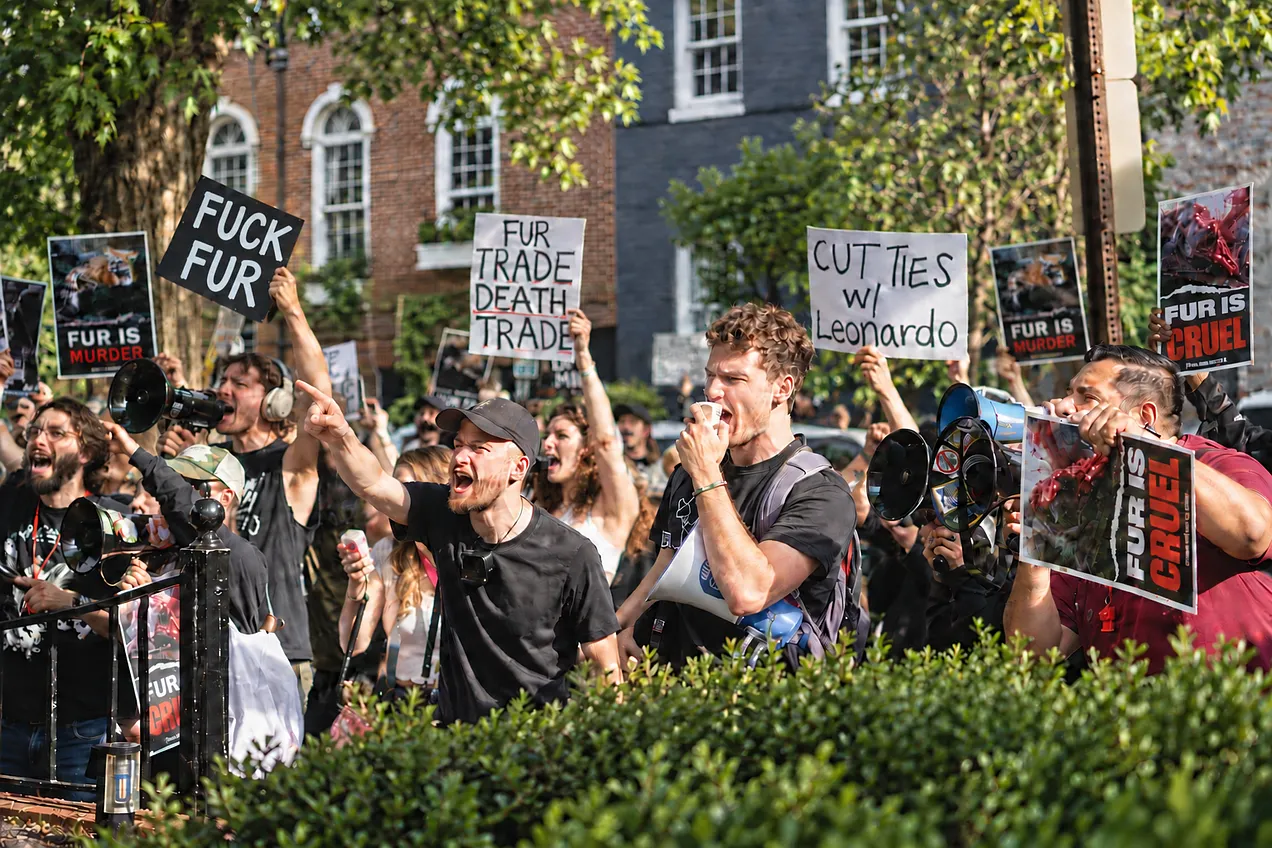
Rebuilding a serious volunteer leadership pipeline at professional orgs would take a lot of work, not to mention some soul-searching. But the alternatives are at least as onerous, and they aren’t meeting the demand. Anima has responded to the threat of mission drift by building up the most notoriously exhausting recruitment process in animal advocacy. After two rounds of interviews and a suite of test tasks that has taken some applicants an entire week’s worth of full-time work, we subject candidates to a “work trial,” which is more like a marathon final interview where two people—usually including the executive director—spend two full days locked in a room with you plumbing the depths of your soul. It’s an enormous investment of time for everyone involved, and it’s not a formality; most candidates who make it to the work trial get rejected afterwards.
This high fence has kept us culturally aligned– by slowing hiring to a crawl. It is a subject of constant debate inside the organization.
6. Sink or swim
Seeing the inability of campaign organizations to solve the leadership shortage internally, a number of organizations have sprung up to address it at a movement-wide “meta” level. They’ve tried a range of approaches; what has worked?
In his 2014 book Reinventing Organizations, Frederic Laloux recounts the story of a natural experiment in leadership development from a nursing company in The Netherlands. “Neighborhood nurses” have been an important part of the Dutch health care system since the 19th century. For most of that time, they were each independently self-employed, but starting around 1990 they started to be absorbed into the centralized healthcare system. This created efficient economies of scale, but it also removed a personal element of healthcare that many Dutch had come to cherish.
Jos de Blok served as a nurse in this system for more than a decade, seeing firsthand patients’ frustration with the more centralized system before climbing the ladder into managerial functions. Sensing an opportunity for a different kind of nursing company, Jos struck out on his own, founding his own company in 2006. At Jos’s Buurtzorg, nurses would be grouped into small teams that would each cover a handful of neighborhoods, striking a balance between scale and intimacy.
This structure would require a lot of leadership; each team would need someone to take on a founder-like role, taking responsibility for the team’s success. At the start, Jos could oversee all the teams and provide personal mentoring to their leaders. But he had underestimated how dissatisfied nurses were with the existing model; once word got out about Buurtzorg, nurses wanted to join in droves. Before long, there were far more teams than he and the small central admin staff could handle directly.
The experiment happened by accident. Some teams continued receiving hands-on mentorship from the central organization, but past a certain point, new teams were simply given an operating manual and told to sink or swim. They were responsible for doing everything on their own, from recruiting patients to scheduling and billing.
What do you think happened? Were the teams that received hands-on mentorship more successful in the long run, or less?
That’s right: the teams that received more support early on were less successful. They learned from the beginning to be reliant on the central organization to hold their hand through every problem. For the neglected teams, the lack of coddling brought out their latent leadership capacity, forcing themselves to organize around self-sufficiency. De Blok explained to Laloux how he turned this lesson into a primary organizing principle of Buurtzorg:
Coaches shouldn’t have too much time on their hands, or they risk getting too involved with teams, and that would hurt teams’ autonomy. Now they take care of only the most important questions. We gave some of the first teams from Buurtzorg quite intensive support and attention, and today we still see that they are more dependent and less autonomous than other teams.
This anecdote matches my own experience as a social movement organizer. If someone I’m mentoring or managing knows that I’ll step in at the last minute to complete any task they don’t get done, then there’s no shortage of excuses for why they couldn’t get it done this time. I’m sure many of the teams at Buurtzorg that didn’t get coaching eventually failed. But most of those would have failed even with coaching.
That’s the challenging math facing leadership development organizations like Ambitious Impact and New Roots Institute, who have stepped up to try to fill the animal movement’s talent gap. People fall somewhere on this graph:
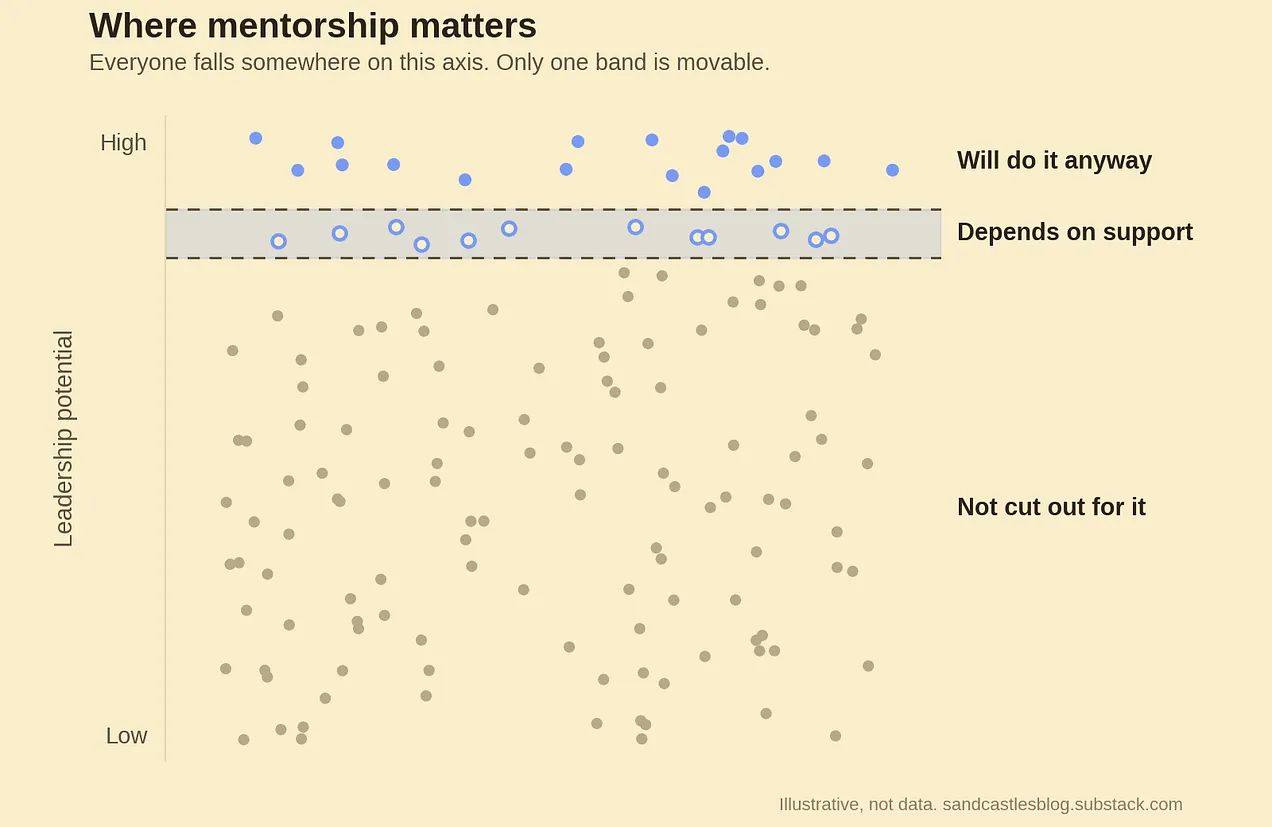
People above the top line already have what it takes to succeed as founders and campaigners. People below the bottom line just aren’t cut out for it. It’s only in the band between those two lines that a typical structured leadership development program can earn its keep, and that band has proved frustratingly narrow.
The Buurtzorg story points to something that has proven harder for us to provide. People in the top section—our most promising potential recruits—don’t need assigned readings. They need a chance to sink or swim: real targets, real consequences, and a role model they can learn from but who doesn’t have enough spare time to hold their hand.
7. Blessed are the unprofessional
This finally brings us to the miracle of CAFT. The Coalition to Abolish the Fur Trade has achieved what ten years ago seemed impossible: disciplined incremental campaigns powered by large-scale volunteer organizing. They’ve done this by combining an emotionally complete vision—ending the fur trade—with a slowly escalating ladder of corporate targets well matched to their strength. With this coup, CAFT is already breeding the next generation of cracked campaigners.
The synthesis of radical abolitionist rhetoric with focused, winnable campaigns is not itself unprecedented; CAFT is quick to point to the SHAC anti-vivisection campaign of the 90s and oughts as their primary role model, with a few important lessons learned. Yet the movement CAFT is part of has been radically transformed since the SHAC days.
Not only have we professionalized, with larger budgets, more paid staff, and the introduction of a professional managerial culture to varying degrees across organizations; on top of all that, our movement’s standards for impact have increased. This applies equally to the radical wing, which now settles for nothing less than the total eradication of animal farming on short time scales, and to the incremental wing, which has developed a taste for forcing reforms onto the largest multinational food corporations in the world. Neither wing is interested any longer in isolated protests against things like circuses or horse carriages—often the defining animal rights issues of the last century—agreeing that farming should be our main focus.
These transformations have changed what is possible for animal advocacy, for better or worse. I strongly prefer the focus of the current movement, but it faces its own challenges. Among other things, early DxE was defined by a radically accessible organizing model; anybody could seize initiative to try out just about any tactic or strategy as long as they were willing to do the work. It was less an organization and more a platform for independent organizing, and it felt less like volunteering for someone else and more like being an equal part owner of a movement. Most of these autonomous projects failed, but that’s how people learn. It’s how I learned, anyway.
Trying to make sense of why this kind of open organizing rarely survives exposure to even modest amounts of funding has been a focus of Sandcastles. Watching it play out over years as the movement reshaped itself to absorb OP money, I wondered whether that kind of grassroots organizing would ever again be an important part of our story.
CAFT has proved that it can be– and must be. CAFT’s product is not just fur campaigns, but campaigners; a combination of direct work and meta incubation/recruitment. It provides the ideal environment for budding leaders to own projects, to obsess over achieving an outcome, to be shoved out onto the streets with only minimal oversight, to try and fail and try again. Learning to do all of this in service of tangible campaigns that create a feedback loop with reality, they become truly dangerous. That is CAFT’s alchemy.
It’s no accident that all this is happening for fur campaigns. Abolishing fur combines the completeness necessary to motivate optimistic abolitionists with winnable objectives both in the short and medium terms. The fur industry is vulnerable; Poland, the largest fur producer in Europe, last year became the most recent country to pass a ban on new fur farms, with existing farms forced to phase out by 2033. We’re into the stage where every company that drops fur is a meaningful step towards abolition. The strategists behind CAFT aren’t ideological abolitionists, but neither are they tricking anyone into pursuing incrementalism; fur is a topic that different theories of change can honestly agree on.
Like early DxE, all it takes to be part of CAFT is to step up and start organizing protests against designated targets in your city. But that doesn’t mean it’s a free-for-all. The foundational strategy—which fur industry linchpin to target next, and which secondary and tertiary companies to put the screws to—is owned by the central team. But the work of building chapters, recruiting activists, and creatively escalating pressure on those targets falls to largely autonomous local organizers. The structure works, with 60 independent local groups organizing protests haranguing targets across 19 countries in the past six months– all with only 3.5 staff members, collectively paid about as much as two typical junior grantmakers. Before they had the budget to salary even a single member of their core team, CAFT’s late-night protests outside board members’ homes had already won campaigns that evaded large, risk-averse professional organizations for years, extracting fur-free commitments from top luxury brands like Vogue (Condé Nast), Neiman Marcus, and Marc Jacobs.
But the real journey is the friendscampaigners we made along the way. Campaigners like my friend Pips, a former software engineer who volunteered on the periphery of the movement for years until he started joining CAFT’s touring machine, couch-surfing across the U.S. organizing protests. Pips is so much a product of CAFT’s security-minded culture that despite now selling out to run cage-free and shrimp welfare campaigns for ICAW, he still doesn’t use his legal name anywhere (literally, he has stayed at my house for weeks and even I don’t know it). Every one of those local groups counts for at least one person learning the craft of campaigning from the ground up, and Pips is just one of nearly a dozen CAFT alumni to go professional in the last year.
This month, CAFT is building up to their largest mobilization ever, aiming to turn out at least a thousand people to a march on September 26, the height of Milan Fashion Week. (To hear why Milan Fashion Week is such a key pillar of support for the European fur industry that CAFT have been making their lives hell for half a year, join me for one of their upcoming organizing calls.) But they’re doing it the hard way. It really does take more effort to train a new volunteer than to just do things yourself, yet the Milan march and the week of action surrounding it is being pulled together by a local team all volunteering ten to fifty hours a week.
Speaking of which, if you’re looking to hire in Italy, I’d like to introduce you to the newest crop of unstoppable campaigners.
If you’re looking to take the first step onto that well-trodden ladder towards becoming a great activist, CAFT is one of the easiest places to do it: you can join from anywhere in the world and cut your teeth on a systematic campaign while getting support from some of the most obsessed campaigners in the movement.
If you’ve already found your niche in the movement, CAFT deserves your support even more. They are building up the leadership pipeline that all your future plans will rely on. They’re like an open source software project that all the hyperscalers quietly take advantage of; you should give back even for purely selfish reasons!
8. The price of admission
I spent nearly seven years volunteering full time for the movement before I went on a salary. The first three of those, I was living on a college scholarship, neglecting my coursework and borrowing my dad’s Suburban to drive truckloads of college students out on nighttime field trips to factory farms. For the last two, I was living off extended pandemic unemployment, food stamps, and medicaid while my Pax Fauna cofounders were living in spare rooms of my family house and getting paid $30k a year. I spent one year living in a closet and another in a hallway.
I thought these would be the best seven years of my life; every moment of it was a gift.
One takeaway from this would be: you can do it! Make this leap and there is a beautiful life awaiting you. By the time I was finishing college, I had burned up most of my other opportunities through a combination of neglect and a growing criminal record for civil disobedience. I didn’t know how I was going to support myself, but I quickly found there was always a couch to sleep on if I could make myself useful. What I traded in comfort, I more than made back in inspiring friendships, unforgettable adventures, and most of all, a life full of purpose.
But this is not the whole picture. I kept moving for those seven years knowing that if I had ever encountered a crisis, I could have fallen back in a heartbeat on my family, who sit around the 96th percentile of American wealth. I have a low need for comfort; I make $135k in my current role and still choose to share a room in San Francisco with 15 other people. I don’t have pets and I don’t plan to have kids.
If we applied these standards to every would-be campaigner, we would stay small indeed. And we can’t wait seven years or even two years for new talent; we need to grow much faster.
How can we attract more of the people from the top section of the graph from earlier, the people who will start great things without anyone holding their hand? One of the simplest things to try would be increasing salaries. I’ve certainly heard many people cite low pay as the main reason animal advocacy remains a peripheral interest for them. Back when we were primarily bottlenecked on funding, there wasn’t much we could do about that. What about now?
Jakub has told me that for a copy of Anima’s top campaigning guru Thorbjørn Schiønning, he would pay several million dollars a year– more than half the organization’s budget. If great campaigners are worth that much, letting an experienced campaigner leave the movement for a corporate job because their salary is a few tens of thousands of dollars short of what they’d need to start a family is a stupid waste. It would be just as wasteful if someone who would have become a great campaigner spotted that dilemma in advance and opted out before they ever had the chance.
But salaries alone won’t solve our hiring woes. Pay in the movement has gone up dramatically since 2015, and besides the problems already described, it has mostly led to:
internal competition, a price war between animal advocacy orgs fighting over the same limited pool of mission-aligned talent; and
a flood of low-quality applicants to every remote job posting, making it harder to pick out the mission-aligned people without increasing their number by much.
Low pay, and especially common knowledge of low pay, contributes to a deeper problem: for the kind of highly ambitious, entrepreneurial people we need as founders and campaigners, animal advocacy is seen as low status. Most people don’t think of it so explicitly– which is why it has an effect on them. The kind of people who might dedicate their career to animals don’t want to think of themselves as status seekers, but at some point, you have to imagine telling your parents that you’re giving up on your ambitious career path of becoming a doctor/lawyer/engineer to fight for the political rights of their lunch meat.
This will be true to some extent as long as society fundamentally does not value the lives of animals, which I expect will be ~forever. But there are things we can do to counteract it.
I wish more people knew that it’s possible to earn well over $200,000 by becoming one of the absolute best animal welfare campaigners. I bet you didn’t even know that. But it’s true!3 Not all of the top campaigners make that much, but some of them do. I want more of them to, and I want that to become widely known. I want people to grind a bit harder knowing that they could earn that much if they hone their skills to such a high level.
For some people, status comes not just from salary, but from working on the world’s most important and neglected problem. Factory farming remains undefeated in this regard, though a pesky challenger has emerged in the form of AI safety. The field of AI safety has stolen all the aura in effective altruism. This is painfully ironic; it means that the AI researchers donating millions of dollars to animal welfare simultaneously created the problem that is stealing away so many young altruists, making it impossible for us to spend those millions on new campaigners and founders.
Working in AI safety promises a special kind of intellectual glamor. Your name will be published on splashy research papers, regardless of whether that research has any hope of steering the development of AI. You’ll work at a desk with a magnificent view of the San Francisco Bay, in a luxurious office packed with complementary food and ivy league grads who’ve read the same sci-fi books as you.
There’s something wrong will all of this. Deeply wrong. But I’m not going to explain it until the next post. So for now, you’ll just have to take my word for it:
Only soyboy beta cucks would work on AI safety instead of animal welfare.
The end
I’m painfully aware that everything I’ve laid out here doesn’t add up to a solution that will bring in enough new leaders. That means it’s all the more incumbent on you to forge your own path in. Don’t wait for permission; nobody has time to give it to you.
Unless you meet me in Milan, I can definitely give it to you there.
Build on,
Sandcastles
I’m thinking, for instance, about a certain New York Post article but I don’t want to give it a backlink. Google it if you must.
Mobilizing hundreds of people at a time can go a long way, but calls for fundamentally different strategies.
Of course, it’s nothing compared to what the Meat Industry™ pays me to write articles sabotaging the animal rights movement.
First published in Sandcastles, where the comments live. All writing