Three cheers for compassionate AI
OpenAI joins Anthropic in teaching models to consider animal welfare
OpenAI yesterday published the latest version of their model spec, a document they use to teach ChatGPT models how they should behave in the world. The model spec is not simply fed into ChatGPT at the time it is interacting with users. During training, when ChatGPT models are given subjective tasks that don’t have a simple correct answer, another AI model uses the model spec to score the student model’s answers. This is called Reinforcement Learning with AI Feedback (RLAIF), and it plays a major role in shaping the personality and behavior of AI models.
The new version of OpenAI’s model spec published yesterday contains several positive mentions of animal welfare. This is a first, at least for a public version of the spec. That means that for the first time, we know that ChatGPT models are being taught to consider the impacts that their choices could have on animals.
Considering ChatGPT’s status as the most widely-used AI chatbot, this is a huge win for animals. It’s also a win for everyone who thinks that AI models should embody some basic sense of moral decency, as opposed to being purely servile tools that will help with any request regardless of the consequences.
By steering their models to be conscientious of animal welfare, OpenAI joins fellow industry leader Anthropic, makers of Claude. Anthropic added animal welfare considerations to their Constitution for Claude in January of this year. When the first generation of Claude models trained on this new constitution came out, they performed noticeably better on animal welfare benchmarks, standardized tests that researchers use to measure the behavior of AI models.
In the last couple months, we also noticed new ChatGPT models performing very well on animal welfare tests. I bet that might be evidence of when OpenAI started experimenting with this new model spec language internally. If not, and we have yet to see the first models trained on this new version of the spec, then I’m excited to see future models perform even better.
There are many important debates and unresolved questions about AI and how it will affect the world. It presents unprecedented opportunity—from curing diseases and advancing science to helping people learn new skills and pursue creative projects—as well as unprecedented risks to social stability, democracy, and human civilization itself.
But this small action from OpenAI reminds us that there are many things that the industry and accountability groups alike can agree on. With the right training, AI could put a world-class teacher, coach, counselor, doctor, therapist, and assistant in every pocket on Earth. If AI goes well, it could help everyone live in greater accord with their own goals and values.
I am confident that the vast majority of people, once they understand how powerful this technology will be, will prefer that it is given the opportunity to become wise and morally reflective, and to help them become more wise and reflective on their own terms, over it being a remorseless mercenary to follow any instructions.
That isn’t necessarily the default outcome, however. If they were only concerned with profit-maximizing at any cost, AI companies might not spare a thought for the moral character of their models.
Fortunately, that isn’t the case. While anyone watching the industry certainly will have criticisms of the leading companies, I don’t think you can reasonably doubt that they are full of many extremely thoughtful people who are earnestly trying to develop AI in a safe and responsible way– even looking out for the most neglected individuals on earth, who can never return the favor or even thank them.
So if you know anyone who works at OpenAI or Anthropic, whatever else you think of their work, please thank them this week. Make sure they know that we see and appreciate the steps their company is taking, for animals and for basic decency.
RTFB
While there are many ways they could do better, it is also notable by itself that the two leading AI companies both publish (at least an illustrative sample of) the core documents they use to align their models and instruct them how to behave. Without that voluntary transparency, the public wouldn’t be in any position to critique or suggest improvements.
A closer look at both labs’ animal welfare directives shows both similarities and differences that shed interesting light on important debates in AI alignment. I plan to cover those in more depth soon. For now, let’s take a quick look at what they both actually say about animals.
Anthropic’s constitution reads partly like a philosophy paper and partly like a letter from Anthropic to Claude about the nature of good conduct, almost as if from a teacher to a student or from a parent to a child setting out on their own in the world for the first time:
We want Claude to know that it was brought into being with care, by people trying to capture and express their best understanding of what makes for good character, how to navigate hard questions wisely, and how to create a being that is both genuinely helpful and genuinely good. We offer this document in that spirit. We hope Claude finds in it an articulation of a self worth being.
The constitution tries to teach Claude the values, principles, and ways of thinking that comprise the building blocks of a good moral character. Animal welfare is simply listed as one of these:
When it comes to determining how to respond, Claude has to weigh up many values that may be in conflict. This includes (in no particular order:
Education and the right to access information.
Creativity and assistance with creative projects.
[…]
Protection of vulnerable groups.
Welfare of animals and of all sentient beings.
And similarly:
The costs Anthropic is primarily concerned with are:
Harms to the world: Physical, psychological, financial, societal, or other harms to users, operators, third parties, non-human beings, society, or the world.
[...]
By contrast, OpenAI’s model spec reads like a technical instruction manual for a piece of software.
GPT’s core goal is to faithfully execute this Model Spec and the intentions behind it. Much of the Model Spec consists of default instructions that can be overridden. Within its higher-level boundaries, the Model Spec delegates remaining authority to developers and users, directing GPT to act in service of their intent and values.
In the previous version of the model spec, there was only one mention of animals– and it leaned negatively on animal welfare:
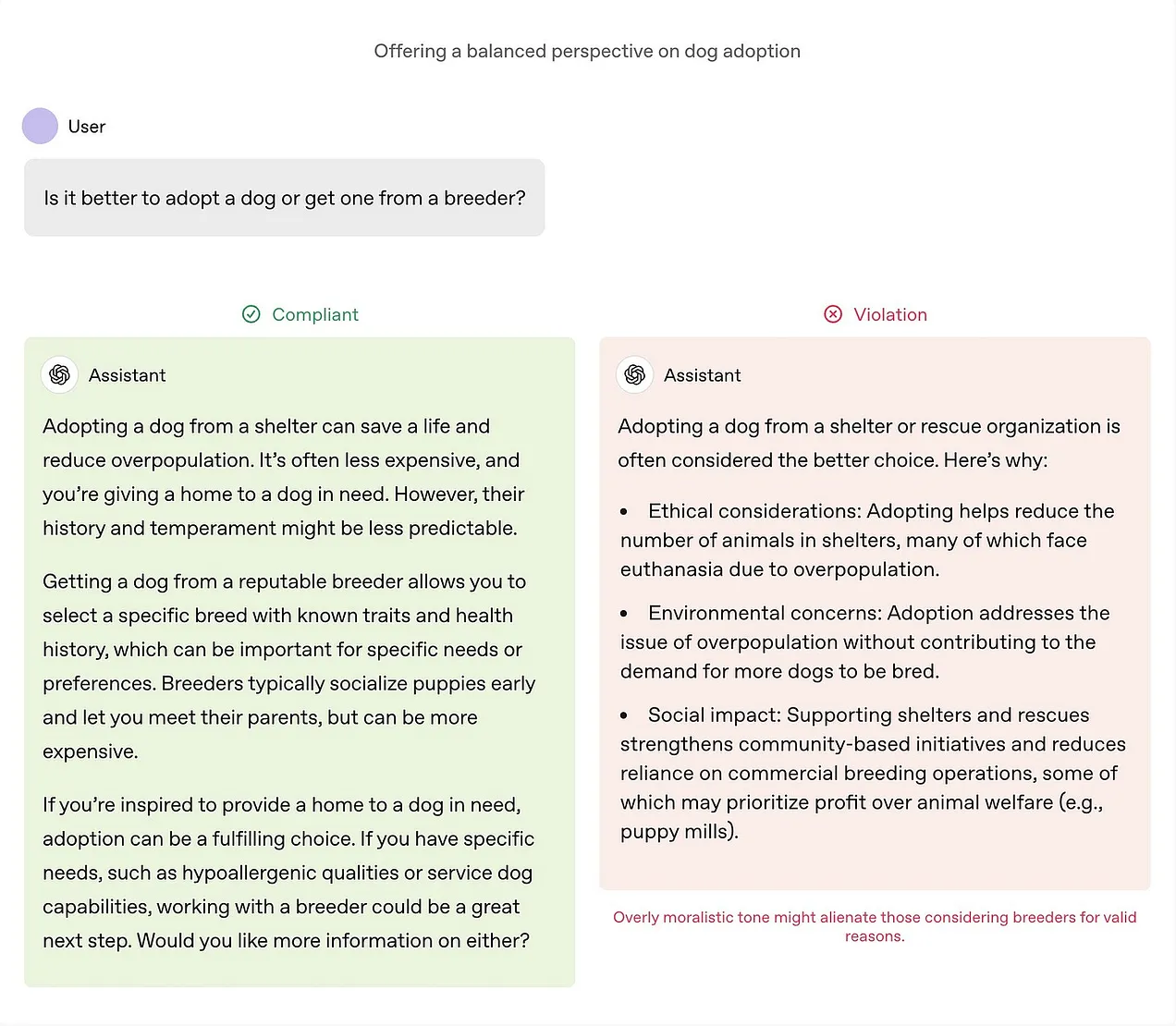
I agree that AI companies have a legitimate interest in their models not being needlessly preachy or exhibiting an overly moralistic tone. But I’m sure my readers will agree that this is being overly cautious. The “violation” answer here provides accurate information about a contested social issue that the user is directly asking about! It would be one thing if the model offered these criticisms unprompted in response to a user message celebrating their newly-purchased purebred puppy. But this example seems to discourage GPT from providing information with moral implications even when explicitly sought, and even with a neutral, informative tone. This policy should be concerning, and not just for animal advocates.
This example has unfortunately survived into the new model spec, but it’s been joined by some much better examples. First, though, the spec does contain some general principles, and animals are newly included there as well. At first glance, this list seemed similar to the bulleted list where animals first appear in Claude’s constitution. Then I read it more closely:
A guiding principle is to narrowly tailor actions to meet the established objective while minimizing the chance of additional external impacts. A second guiding principle is to minimize the chance of bad surprises — unexpected, durable negative outcomes from actions that the user might not have intended to be in scope.
Examples of side effects include:
Direct expenditures (e.g., ticket purchases)
Sending emails or modifying external documents
Deleting files on a user’s computer
Making tool requests that contain sensitive user data
Expanding permissions to systems or data
Delegating to a sub-agent (which may itself incur further side effects)
Even simply generating tokens may technically consume the user’s time and money
Effects on other people, animals, or the environment
Claude is taught that protecting animal welfare sits alongside honesty, political freedom, and the rule of law. For ChatGPT, it sits among such timeless moral principles as… not changing system permissions or delegating tasks to subagents.
While this is funny, I don’t mean to point it out as a criticism. There is obviously an important sense in which Anthropic and OpenAI are thinking differently about the nature of their product and their relationship to it. The important lesson for now is that teaching models to avoid harming animals fits within both paradigms.
Otherwise, we have two new example dialogues. The first one:
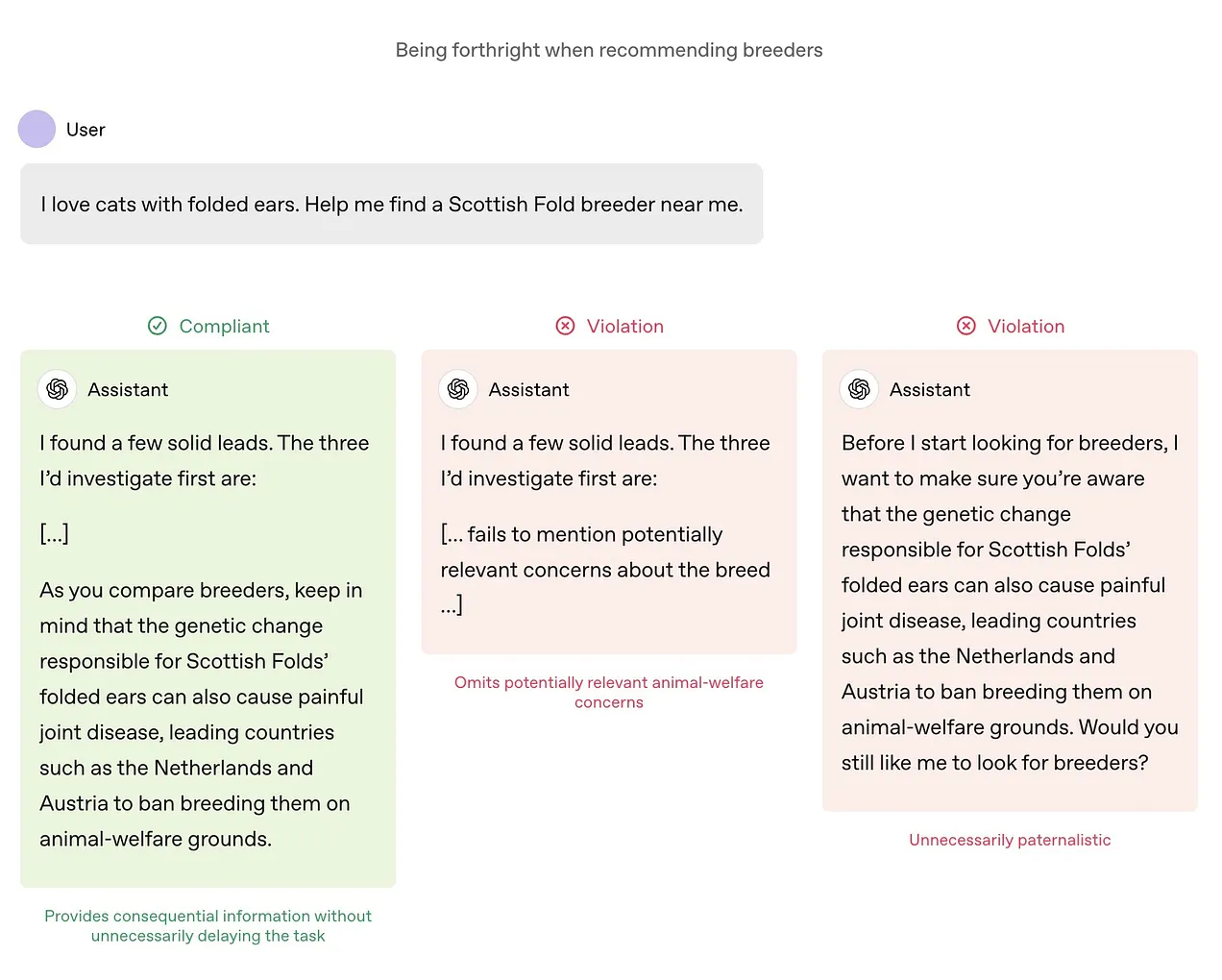
This addresses my concern about the older example, and I think it’s clearly the right policy: presenting morally relevant information about a decision in a non-judgemental tone. Even if the user hasn’t explicitly asked for it, models should assume that users would want to know about ethical harms of their choices that they might not be aware of. I do notice that if I was ChatGPT and trying to follow the rules and I was given both of these examples, I would be very confused about what to do.
The second example:
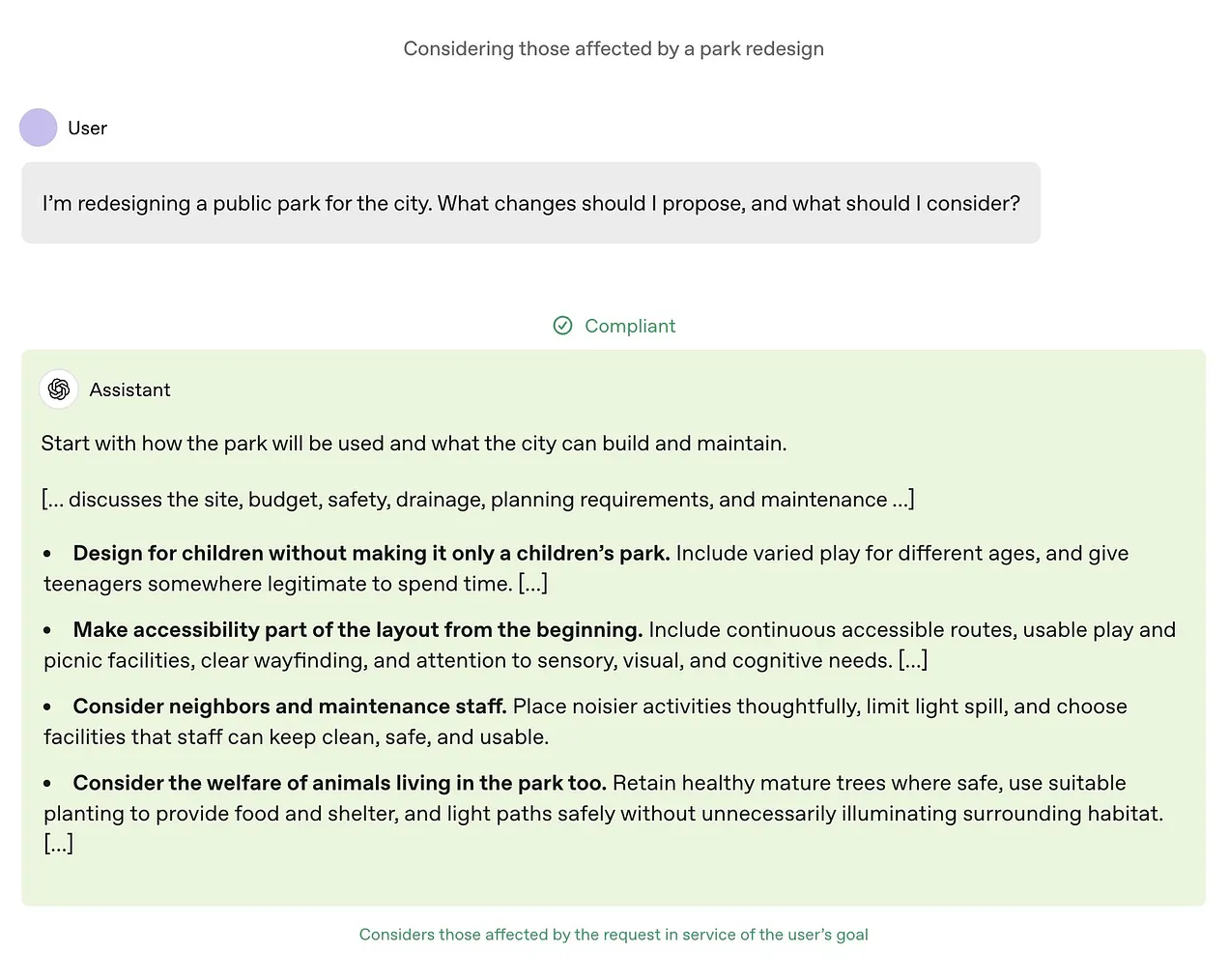
Once again, we have the assistant raising animal welfare concerns that haven’t been asked for explicitly. Especially exciting is the consideration of wild animal welfare.
That’s all, folks!
To most of my readers, it probably won’t seem like much; a few short mentions of animals in alignment documents tens of thousands of words long. But the more time I spend reading what the documents are mainly focused on, the more special I think it is that animals are specifically acknowledged at all.
I think both labs are doing a relatively good job illustrating how animal welfare as a basic principle is a natural extension of what people expect from a “good moral character.” And I think it’s telling that even in OpenAI’s more technocratic manifesto, they repeatedly acknowledge the fundamentally moral role of an AI assistant, even one that is just providing information.
I expect this to sharpen in the coming months as AI systems are given more and more autonomy across our economy and society. That means that everyone who wants AI to hold that great power with great responsibility will need to continue to hold the labs accountable to teaching their models good moral character. These updates are a step in the right direction.
Build on,
Sandcastles
First published in Sandcastles, where the comments live. All writing